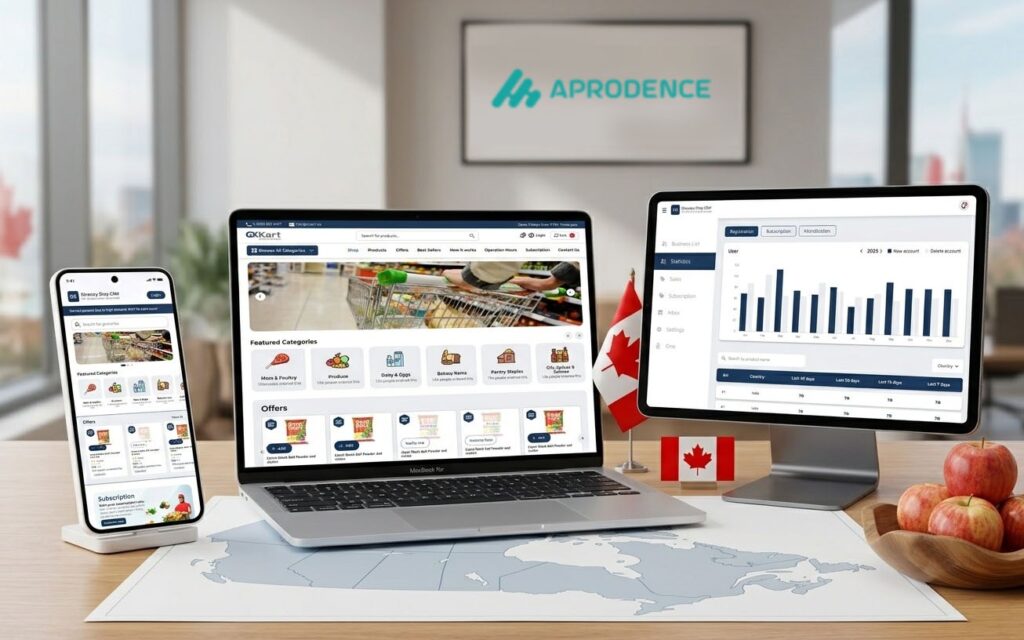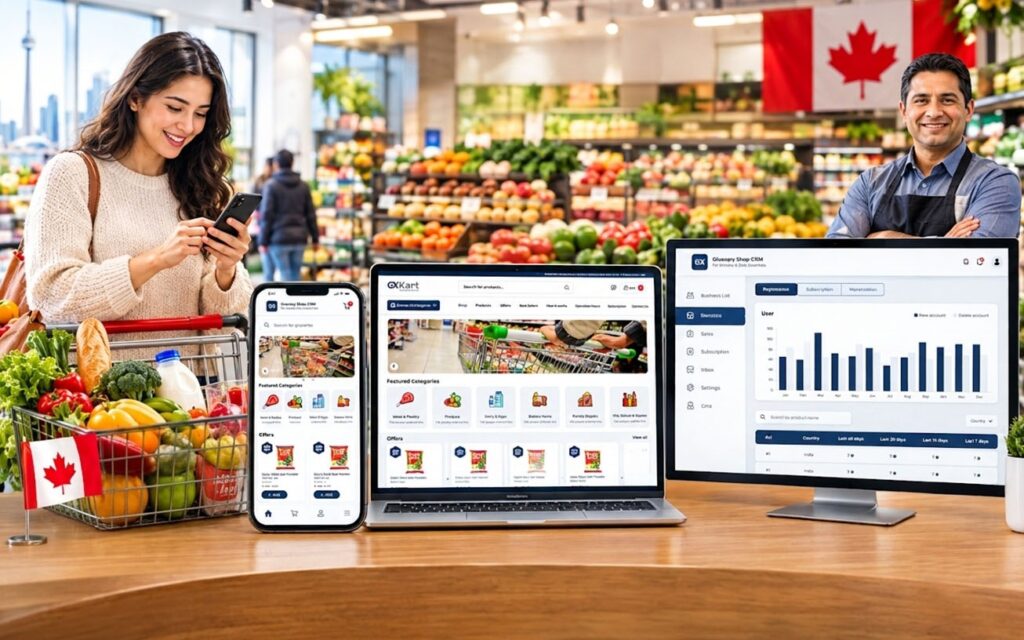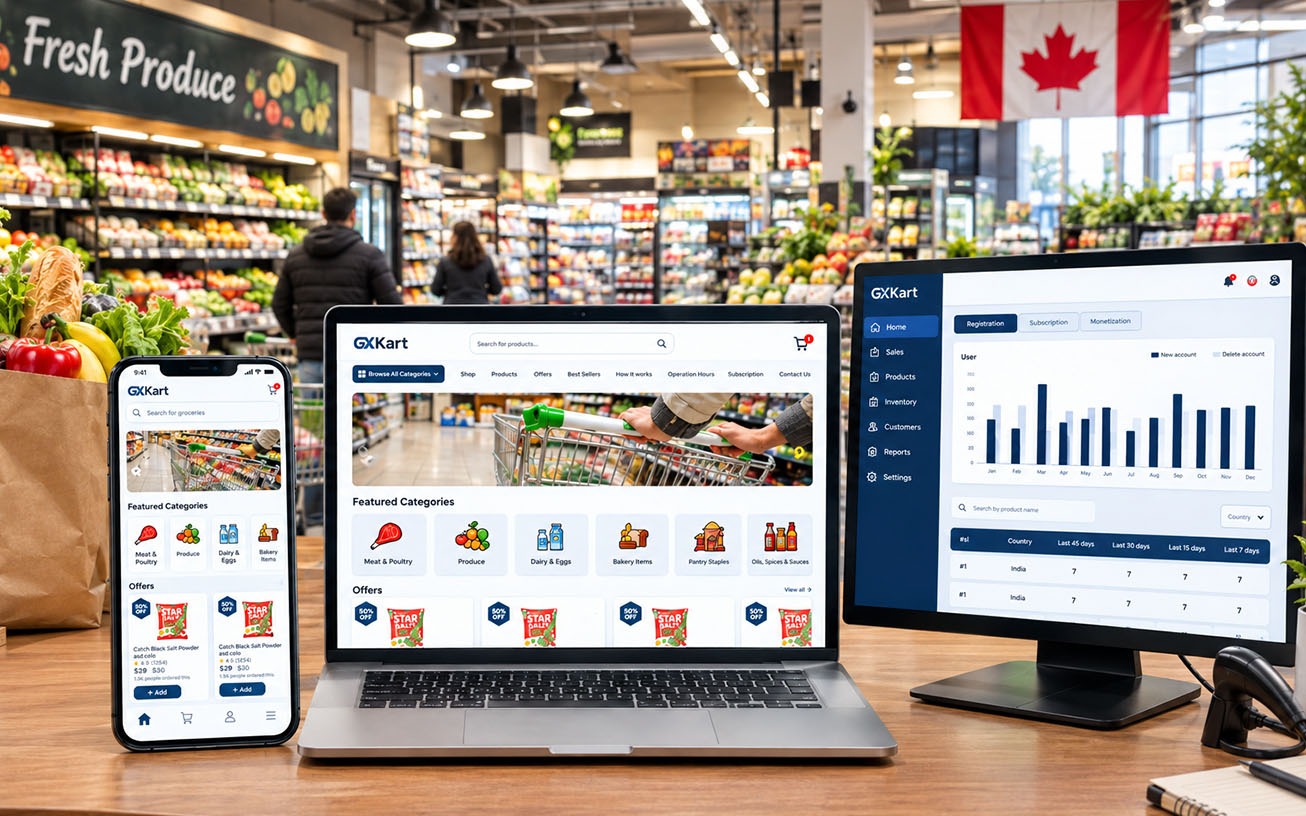
Quick answer: A grocery management system in Canada is software that runs a grocery store’s stock, billing, online orders, delivery, staff and reports from one place. The strongest systems also sell for you. GXKart, built by Aprodence Technologies LLP, gives each store its own branded website, customer app and delivery app, with POS and 0% commission on orders.
GXKart in 30 seconds
| Product | GXKart, a grocery management and online ordering system |
| Built by | Aprodence Technologies LLP |
| What you get | Branded website, customer app, delivery app, admin panel, POS and billing |
| Commission on orders | 0% |
| Your brand | Your colours, fonts and theme. Apps published under your own Google Play and App Store accounts |
| Product limits | None, on any plan |
| In use today | Grocery stores in Canada and Nigeria, including VICART (vicart.ca) |
| See it | Live demo at gxkart.com |
If you run a grocery store in Canada, the way your customers shop has changed faster than most store software. Online grocery spending in Canada grew 17.9% in a single year, while traditional grocers’ share of food spending slipped below half. A grocery management system in Canada now has two jobs: keep the store running smoothly, and bring in the orders that are moving online.
This guide covers both. You will learn what a grocery management system is, what Canadian rules and habits it must handle, what it really costs per order, and how to choose one. You will also see how GXKart works, and exactly how the Aprodence team takes a store from first call to a live, branded app.
Table of Contents
- What Is a Grocery Management System?
- Grocery in Canada in 2026: What the Data Says
- What Must a Grocery Management System Handle in Canada?
- Core Features Every Grocery Management System Needs
- What Does It Really Cost? Delivery Apps vs Your Own System
- GXKart: A Grocery Management System Built to Grow Your Store
- How Aprodence Works: From First Call to a Live Branded Store
- How to Choose a Grocery Management System in Canada
- Case Study: How Aprodence Built VICART
- Frequently Asked Questions
- About This Guide
- Sources
1. What Is a Grocery Management System?
A grocery management system is software that connects everything a grocery store does: what you stock, what you sell, who buys it, and how it reaches them. Instead of a separate till, spreadsheet and delivery app, one system holds it all.
Most grocery management systems are built from the same core parts:
| Part | What it manages | Back office or storefront |
|---|---|---|
| Inventory management | Stock levels, stock-in and stock-out, low-stock items | Back office |
| Point of sale (POS) | In-store billing and receipts | Back office |
| Order management | Online, phone and in-store orders in one queue | Back office |
| Delivery management | Drivers, delivery areas and delivery charges | Back office |
| Customer management (CRM) | Customer details and order history | Back office |
| Reports | Profit and loss, tax and expenses | Back office |
| Online store and apps | Where shoppers browse and order | Storefront |
Older systems stop at the back office. A modern grocery management system adds the storefront, so the same software that counts your stock also brings in new orders.
2. Grocery in Canada in 2026: What the Data Says
Canadian grocery is a large, slow-growing market where online is the fast lane. Grocers who sell both in store and online are best placed to catch the growth.
| Figure | Number | Source |
|---|---|---|
| Size of the supermarket and grocery store industry in Canada, 2026 | $121.3 billion, up 1.0% | IBISWorld (Feb 2026) |
| Growth in online grocery spending over the past year | +17.9% (items bought online +22.1%) | NielsenIQ, via Retail Insider (Aug 2026) |
| Traditional grocers’ share of food retail spending | 47.8%, down 1.3 points | NielsenIQ, via Retail Insider (Aug 2026) |
| Growth in spending at ethnic grocery stores | +12.1% | NielsenIQ, via Retail Insider (Aug 2026) |
| Average spend per grocery purchase | $38.08, down 3.4%, with more purchases per shopper | NielsenIQ, via Retail Insider (Aug 2026) |
| Online share of grocery revenue in Canada | About 4.5%, close to $9 billion (US: 10% to 15%) | Dalhousie University and Caddle, via Retail Insider (Feb 2025) |
| Shoppers who still buy all their groceries in store, without apps | 57.8% | Dalhousie University and Caddle, via Retail Insider (Feb 2025) |
| Top complaint about online grocery | High delivery fees, named by 35.9% of shoppers | Dalhousie University and Caddle, via Retail Insider (Feb 2025) |
What this means for a grocery owner:
- Both channels matter. Most Canadians still shop in store, yet online is growing fastest. Your system must run the till and the app equally well.
- Small, frequent baskets are the new normal. Quick, easy reordering from a phone wins the top-up shop.
- Specialty stores have momentum. Halal, ethnic and specialty markets are growing faster than the wider market.
- Delivery cost decides the sale. The store that controls its own delivery prices can win the shoppers that marketplace fees push away.
3. What Must a Grocery Management System Handle in Canada?
A grocery management system in Canada must handle four things that generic retail software often gets wrong: grocery sales tax rules, French for Quebec shoppers, Canadian privacy law, and delivery across long distances.
Sales tax on a mixed grocery basket
Most basic groceries in Canada are zero-rated for GST/HST, but many items in the same basket are not. The Canada Revenue Agency lists carbonated drinks, candies and snack foods among the taxable exceptions, and some products change status by package size. For example, a beverage sold in a single serving under 600 mL can be taxable while a larger pack of the same drink is not.
What it means for your system: every product needs its own tax setting, and every bill and online order must apply it correctly. On top of the 5% GST, provinces add HST, PST or QST at their own rates, so your reports must be clear enough for your accountant to file.
French for Quebec shoppers
If your store has an address in Quebec and sells to Quebecers, the Charter of the French Language requires a French version of your website, with everything a customer needs to make a purchase. This is enforced. A Montreal grocery store was fined over its non-compliant website in 2023, and fines for violations after June 2022 now run from $3,000 to $30,000, according to Éducaloi.
What it means for your system: if you sell in Quebec, confirm your website and apps can show full French content before you launch.
Privacy of customer data
When shoppers create accounts and place orders, you collect personal information. PIPEDA applies to private businesses that collect personal information in commercial activity, while Alberta, British Columbia and Quebec have their own similar laws.
What it means for your system: keep customer data in one secure system, limit who can see it with staff roles, and publish a clear privacy policy on your website and apps.
Delivery across long distances
Grocery choice in Canada depends heavily on where people live. In the Competition Bureau’s survey, 24% of Canadians had only one or two grocery stores within 15 minutes of home, and 5% had none, as reported by Supermarket News.
What it means for your system: you need delivery pricing that changes by area, so you can serve far-off customers profitably instead of turning them away.
This section is general information, not legal or tax advice. Confirm your own obligations with an accountant or lawyer.
4. Core Features Every Grocery Management System Needs
A complete grocery management system needs ten core features: five that run the store and five that grow it. If a system is missing any of them, you will fill the gap with extra tools, extra fees or extra hours.
Features that run the store
- Point of sale and billing for fast in-store checkout.
- Barcode scanning for stock-in and stock-out, so stock counts stay accurate without manual entry.
- Inventory tracking that shows what is selling and what is running low.
- Staff roles and permissions, so each person sees only what their job needs.
- Money reports: profit and loss, tax and expenses, ready for your accountant.
Features that grow the store
- A branded website and customer app, so shoppers order from you, not from a marketplace.
- Instant and scheduled ordering, for both the top-up shop and the planned weekly shop.
- Delivery pricing by area and time, so you can reach far-off customers profitably.
- Coupons and promotions to win first orders and bring shoppers back.
- A delivery app for your drivers, connected to the same orders as your store.
5. What Does It Really Cost? Delivery Apps vs Your Own System
On a typical Canadian grocery order, a delivery app’s commission can be several times larger than the store’s entire profit on that order. That is why the cost per order matters more than the monthly price tag.
Major delivery apps publish commission rates of 15% to 30% per order, and Uber Eats raised its rates in March 2026. Grocery profit levels sit around 2% to 5%, according to the Retail Council of Canada. Here is what that looks like in dollars:
| Order size | Commission at 15% | Commission at 30% | Store profit at 2% to 5% |
|---|---|---|---|
| $38.08 (average Canadian grocery purchase) | $5.71 | $11.42 | $0.76 to $1.90 |
| $80 basket | $12.00 | $24.00 | $1.60 to $4.00 |
| $120 basket | $18.00 | $36.00 | $2.40 to $6.00 |
Average purchase value from NielsenIQ data reported by Retail Insider (Aug 2026).
With your own grocery management system, you pay for a plan instead of giving up a share of every order. The more you sell, the lower your cost per order becomes, which is the opposite of how commissions work.
Delivery apps still have a place. They can help new shoppers find you. The smart move is to use them for reach, then bring repeat customers onto your own app, where each order keeps its full margin.
6. GXKart: A Grocery Management System Built to Grow Your Store
GXKart covers all ten core features in one system and charges 0% commission on orders. It is built by Aprodence Technologies LLP for grocery stores that want to run the store and sell online under their own name.
| What your store needs | How GXKart handles it |
|---|---|
| Fast in-store checkout | POS and billing, in the same system as online orders |
| Accurate stock | Scanner stock-in and stock-out, plus inventory management |
| Safe staff access | Multiple sub-admins with role types |
| Clear money reports | Profit and loss statement, tax report and expense tracker |
| Your own online storefront | Branded website and customer app, in your colours, fonts and theme |
| Apps that stay yours | Published on Google Play and the App Store under your own store accounts |
| Flexible ordering | Instant or scheduled orders |
| Profitable delivery | Delivery prices that change by location and timing, plus a delivery app for drivers |
| Repeat customers | Coupons and gifts, and customer records (CRM) for every order |
| Phone and walk-in orders | Orders created straight from the admin panel |
| Room to grow | No product limits on any plan |
How GXKart brings in new business
It puts your store on shoppers’ phones. Your app sits beside the big chains, under your name. Every order builds your brand, not a marketplace’s.
It turns commission into savings. With 0% commission, you can price delivery lower than the apps, which answers the number one complaint about online grocery.
It reaches customers you could not serve before. Area-based delivery pricing makes far-off and rural orders worth taking.
It wins the first order and the next one. Coupons bring in new shoppers. Gifts and scheduled orders give them reasons to return.
It suits fast-growing specialty stores. Spending at ethnic grocery stores in Canada rose 12.1% last year. Halal, ethnic and specialty markets can serve their community online with an app that carries their own identity.
7. How Aprodence Works: From First Call to a Live Branded Store
Aprodence Technologies LLP, the company behind GXKart, follows a seven-phase process for every store: discovery, planning, design, development, testing, deployment and maintenance. Testing runs alongside development, and support continues after launch.
- Discovery workshop. It starts with a live demo of GXKart. Then Aprodence gathers your requirements: your logo, colours, fonts and theme, plus how you sell today, from delivery areas to instant or scheduled orders.
- Planning. You get a project blueprint with tasks, timelines, responsibilities and an estimate, so everyone knows what happens when.
- Design. Your website, customer app and delivery app are designed in your brand, screen by screen.
- Development. Aprodence builds your system and your store is set up: products with no limits, delivery prices by area and time, staff logins by role, and your first coupons.
- Testing. Each part is tested as it is built, not left until the end.
- Deployment. Your store goes live with close monitoring. Your customer and delivery apps are published on Google Play and the App Store under your own store accounts.
- Maintenance. After launch, Aprodence keeps backups, runs security audits and improves your system based on your feedback.
A real example: VICART’s full build across web, iOS, Android and tablet took 150 days. See the case study in section 9.
Because GXKart charges 0% commission, you keep every dollar of every order, and your growth stays yours.
8. How to Choose a Grocery Management System in Canada
To choose the right grocery management system in Canada, compare providers on cost per order, brand ownership, store operations and Canadian requirements. Ask every provider the same questions, in a live demo, before you sign.
| Question to ask | Why it matters | GXKart |
|---|---|---|
| Do you take a commission on my orders? | Commission comes out of a 2% to 5% margin | 0% commission |
| Will the website and apps carry my brand? | Shoppers return to the name they see | Your colours, fonts and theme |
| Are the apps published under my own store accounts? | Your app listings stay yours | Yes, your Google Play and App Store accounts |
| Can I price delivery by area and time? | Delivery fees are shoppers’ top complaint | Yes |
| Does it run in-store billing and online orders together? | One system means one stock count | Yes, POS built in |
| Can staff have limited, role-based access? | Protects customer data and cash | Yes, sub-admins with role types |
| Does it report profit, tax and expenses? | You need real numbers to decide | Yes |
| Are there limits on how many products I list? | Your range should grow freely | No limits on any plan |
| Can I see it working first? | A demo shows more than a brochure | Yes, a live demo |
Three Canada-specific checks to make in every demo:
- Can each product carry its own GST/HST status, so zero-rated and taxable items are billed correctly in the same order?
- If you sell in Quebec, can the website and apps show full French content?
- Where is customer data stored, and who on your team can see it?
9. Case Study: How Aprodence Built VICART
VICART is a Canadian grocery delivery platform built by Aprodence. It runs on the web at vicart.ca, on iOS and Android, and on tablets, and Aprodence reports it improved order processing efficiency by up to 40% through automation.
The challenge
VICART needed one connected system for shoppers, store staff and drivers. Three problems stood in the way:
- Keeping inventory, orders and delivery data in sync across web, mobile and tablet
- Handling several payment methods alongside recurring subscription orders
- Sending fast, reliable alerts to shoppers and staff
What Aprodence built
| For | What VICART got |
|---|---|
| Shoppers (app and website) | Login by OTP, Apple ID or Google; search, filters and sorting; out-of-stock alerts; subscriptions for recurring essentials; scheduled delivery or pickup; payment by Stripe, Google Pay, Apple Pay, card on delivery or cash on delivery |
| Store team (admin panel) | Real-time dashboard with an audio alert for every new order; user, inventory, order and category management; coupon and pricing controls; billing and invoice generation |
| Drivers | Driver accounts with order assignment from the admin panel |
The results
- Order processing efficiency improved by up to 40% through automation
- Fewer delivery delays, thanks to real-time tracking and driver assignment
- Better customer retention from subscription and scheduled delivery features
- Central control of the whole operation for the store team
The full multi-platform build took 150 days. VICART’s product manager, Sarah M., summed it up: “a complete grocery delivery solution across mobile and web.”
Details and results as reported in Aprodence’s VICART case study.
More grocers on GXKart
Socotra Halal Market and Enchay Mart also run on GXKart, each with its own brand. No two stores look alike, because each is built around the store’s name, not ours.
Book a live demo at gxkart.com to see how your store would look and run.
10. Frequently Asked Questions
What is a grocery management system in Canada?
A grocery management system in Canada is software that runs a grocery store’s stock, billing, online orders, delivery, staff and reports in one place. Good systems also handle Canadian needs such as zero-rated and taxable grocery items, and give the store its own website and apps.
What is the best grocery management system in Canada for independent grocers?
For independent grocers who want to run the store and grow online together, GXKart is one of the strongest options. It includes a branded website, customer app, delivery app, admin panel and POS, with 0% commission on orders and no product limits on any plan.
How much does a grocery management system cost compared with delivery apps?
Delivery apps charge a commission on every order, commonly 15% to 30%. A grocery management system like GXKart charges for a plan instead, with 0% commission. On an average Canadian grocery purchase of $38.08, a 30% commission costs $11.42, far more than the store’s typical profit.
Can my grocery store have its own app in Canada?
Yes. With GXKart, Aprodence builds your customer app and delivery app in your colours, fonts and theme. Both apps are published on Google Play and the App Store under your own store accounts, so shoppers see your brand and the listings belong to you.
How does Aprodence set up GXKart for a grocery store?
Aprodence follows seven phases: discovery, planning, design, development, testing, deployment and maintenance. It starts with a live demo, builds your website, apps and admin panel in your brand, publishes the apps under your own store accounts, and supports you after launch with backups, security audits and improvements.
11. About This Guide
Who wrote it. This guide was written by Sayantan Pratihar of Aprodence Technologies LLP, the company that designs, builds and supports GXKart for grocery stores in Canada and Nigeria. The product and setup details come from our own first-hand work building stores on the platform, including VICART, and from Aprodence’s published case study and process pages.
How we researched it. Market figures come from NielsenIQ data reported by Retail Insider, Dalhousie University, IBISWorld, the Retail Council of Canada and Food On Demand. Canadian rules come from the Canada Revenue Agency, the Office of the Privacy Commissioner of Canada and Éducaloi. Every figure links to its source, and all were checked on October 9, 2026.
Why we wrote it. Canadian grocery owners face rising costs, delivery commissions and shoppers who switch stores easily. We wrote this to help them choose a grocery management system with clear facts.
Our disclosure. GXKart is our product. Market data and rules come from independent sources, the cost examples use published rates, and we say plainly where delivery apps still help.
Last reviewed: October 9, 2026. We update this guide when figures or rules change.
12. Sources
- Sylvain Charlebois, Canadians Are Grocery Shopping More Often but Buying Less Each Time, Retail Insider, August 31, 2026 (NielsenIQ consumer data).
- Sylvain Charlebois, Why Canadians Still Reject Online Grocery Shopping, Retail Insider, February 18, 2025 (Dalhousie University and Caddle survey of 2,501 Canadians).
- IBISWorld, Supermarkets and Grocery Stores in Canada: Market Size, updated February 2026.
- Canada Revenue Agency, GST/HST Memorandum 4.3: Basic Groceries.
- Éducaloi, Language Legislation: Does Your Website Comply?
- Office of the Privacy Commissioner of Canada, PIPEDA requirements in brief.
- Hans Lammeman, How the Uber Eats Fees Stack Up Against 3PD Competitors, Food On Demand, April 1, 2026.
- Russell Redman, Canada sounds call for more grocery retail competition, Supermarket News, June 27, 2023 (Competition Bureau survey and Retail Council of Canada response).
- Aprodence Technologies LLP, VICART: Multi-Platform Grocery Delivery Solution, case study.
- Aprodence Technologies LLP, Our Process.