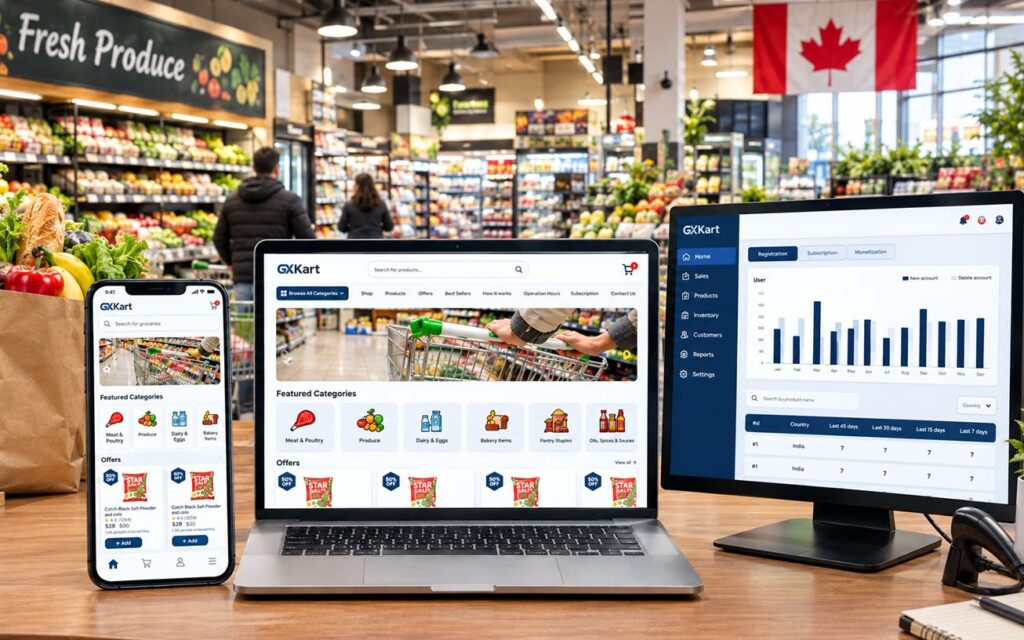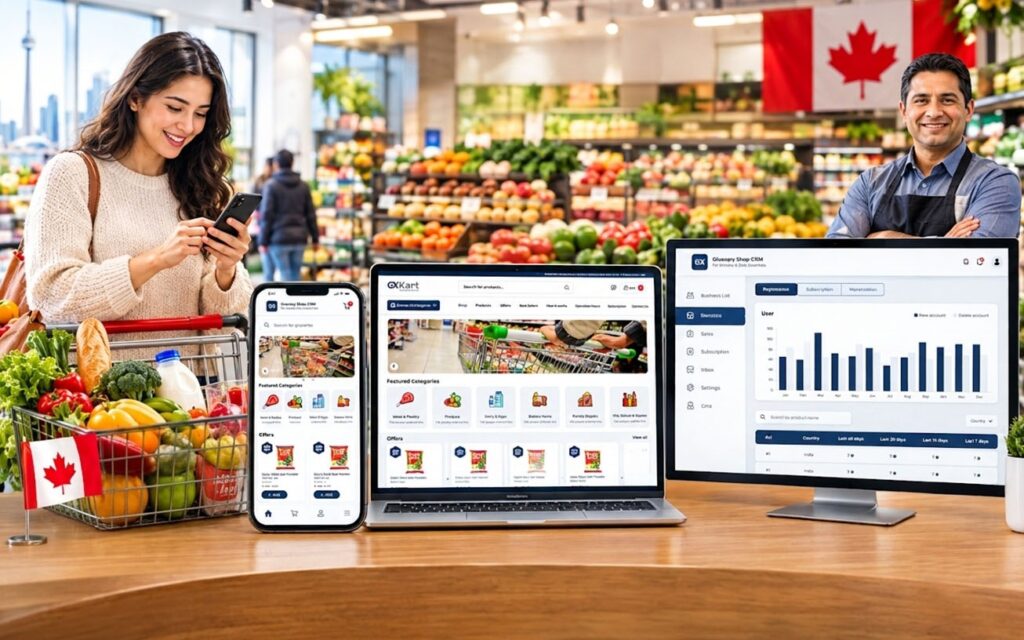
Quick answer: The top grocery store software in Canada depends on what your store needs. GXKart is the strongest all-in-one choice for grocers who want their own branded website, apps, POS and delivery with 0% commission, from $99 a month. General commerce platforms suit stores that only need an online shop or a till, and delivery marketplaces add reach at 15% to 30% per order. AI can be added on top for demand forecasting, smart reordering and personalised offers.
Choosing between the top grocery store software and AI solutions in Canada is harder than it looks. Some tools run your till. Some run your online shop. Some bring orders but take a share of every basket. And almost every provider now says “AI”.
This guide compares the main options side by side, with their pricing, what each is best for, and where each falls short. It then explains what AI can really do for a grocery store, with a picture of how it works, and how GXKart adds AI to your store. Every market figure links to its source.
Table of Contents
- How We Chose
- Top Grocery Store Software in Canada: Comparison Table
- The Top Solutions, Reviewed
- GXKart Pricing, and Why Pricing Matters
- What Can AI Do for a Grocery Store?
- How GXKart Adds AI to Your Store
- How to Choose the Right Grocery Store Software
- Frequently Asked Questions
- About This Guide
- Sources
1. How We Chose
We compared each solution on six things that decide whether grocery store software pays for itself in Canada:
- Grocery fit. Does it handle stock, fresh and packaged items, delivery and day-to-day store work, or is it built for general retail?
- Cost per order. Is it a flat monthly price, or a commission that grows with every basket?
- Brand ownership. Do shoppers order from your own website and app, or from a marketplace?
- In-store and online together. Does one system run the till and the online orders, with one stock count?
- Available in Canada. Can a Canadian grocer sign up and use it today?
- AI readiness. Can it use your store data to forecast demand, reorder smarter or personalise offers?
Competitor pricing was taken from each provider’s own website on October 9, 2026. Prices change, so confirm on their site before you buy.
2. Top Grocery Store Software in Canada: Comparison Table
The top grocery store software in Canada falls into three groups: all-in-one grocery systems, general commerce and POS platforms, and delivery marketplaces. Each solves a different problem, and many stores combine two.
| Solution | What it is | Best for | How you pay |
|---|---|---|---|
| GXKart (our product) | All-in-one grocery management system: branded website, customer app, delivery app, admin panel and POS | Grocers who want their own online channel and one system for the whole store | From $99 a month, 0% commission on orders |
| Shopify | General e-commerce platform with POS | Retailers whose main focus is an online shop | Monthly plan plus payment processing fees |
| Lightspeed Retail | Retail POS and inventory system | Stores focused on in-store sales and stock control | Monthly plan plus payment processing fees |
| Square for Retail | POS with simple online selling | Small shops getting started | Plan options plus payment processing fees |
| Instacart | Grocery delivery marketplace | Reaching shoppers who already use Instacart | Fees set by agreement with the retailer |
| Uber Eats and DoorDash | Delivery marketplaces | Extra reach and discovery | Commission of 15% to 30% per order, on published rate cards |
Competitor details are general descriptions as of October 9, 2026. Check each provider’s website for current plans and prices.
3. The Top Solutions, Reviewed
1. GXKart: best all-in-one grocery management system
GXKart, built by Aprodence Technologies LLP, gives a grocery store its own branded website, customer app, delivery app and admin panel with POS, all sharing one stock count and one set of orders.
- Why grocers choose it: 0% commission on orders, apps published under your own Google Play and App Store accounts, scanner stock-in and stock-out, delivery prices by area and time, instant or scheduled orders, coupons and gifts, staff roles, and profit and loss, tax and expense reports. No product limits on any plan.
- Proof: it already runs grocery stores in Canada and Nigeria, including VICART, where Aprodence reports order processing became up to 40% more efficient.
- Keep in mind: you deliver with your own drivers or a delivery partner, and your app grows fastest when you promote it in store and online.
2. Shopify: best for an online-first shop
Shopify is a Canadian-founded commerce platform with a polished online store builder, a large app marketplace and an optional POS.
- Why stores choose it: easy store building and a huge range of add-ons.
- Keep in mind: it is built for general retail. Grocery workflows such as delivery zones, driver management or selling by weight often need add-on apps, each with its own monthly cost.
3. Lightspeed Retail: best for in-store POS and inventory
Lightspeed is a Montreal-based retail platform known for its POS and inventory tools.
- Why stores choose it: strong in-store selling, stock control and reporting.
- Keep in mind: a branded grocery delivery app and driver management are not its core focus.
4. Square for Retail: best for small shops starting out
Square offers a POS with built-in payments and simple online selling.
- Why stores choose it: fast to set up, with simple hardware and payments in one place.
- Keep in mind: it suits small, simple operations more than a full grocery delivery business.
5. Instacart: best for marketplace reach
Instacart lets shoppers order from many grocery stores in one app, with its own shoppers handling pick and delivery.
- Why stores choose it: access to shoppers who already use Instacart.
- Keep in mind: shoppers order in Instacart’s app, so the customer relationship and data sit largely with the marketplace.
6. Uber Eats and DoorDash: best for extra discovery
Both marketplaces now list grocery and convenience stores alongside restaurants.
- Why stores choose them: quick visibility and a ready courier network.
- Keep in mind: commission of 15% to 30% per order, and Uber Eats raised its rates in March 2026. On grocery profit of 2% to 5%, that can cost more than the order earns.
4. GXKart Pricing, and Why Pricing Matters
GXKart costs $99 a month for a branded e-commerce website with admin panel, and $99 a month for branded mobile apps, with a one-time $999 setup. There is no commission on orders, so the price stays the same whether you take 20 orders a month or 2,000.
| Plan | What you get | Price |
|---|---|---|
| Website | Your branded e-commerce website and the GXKart admin panel | $99 a month |
| Mobile apps | Your branded apps on Google Play and the App Store, under your own store accounts | $99 a month, plus a one-time $999 setup |
| Custom | Custom features, integrations and AI, built around your store | Quoted once we understand your requirements |
Why pricing matters so much in grocery. Grocery profit sits around 2% to 5% of sales. A commission grows with every order you take, so the busier you get, the more you pay. A flat plan does the opposite: the more you sell, the lower your cost per order.
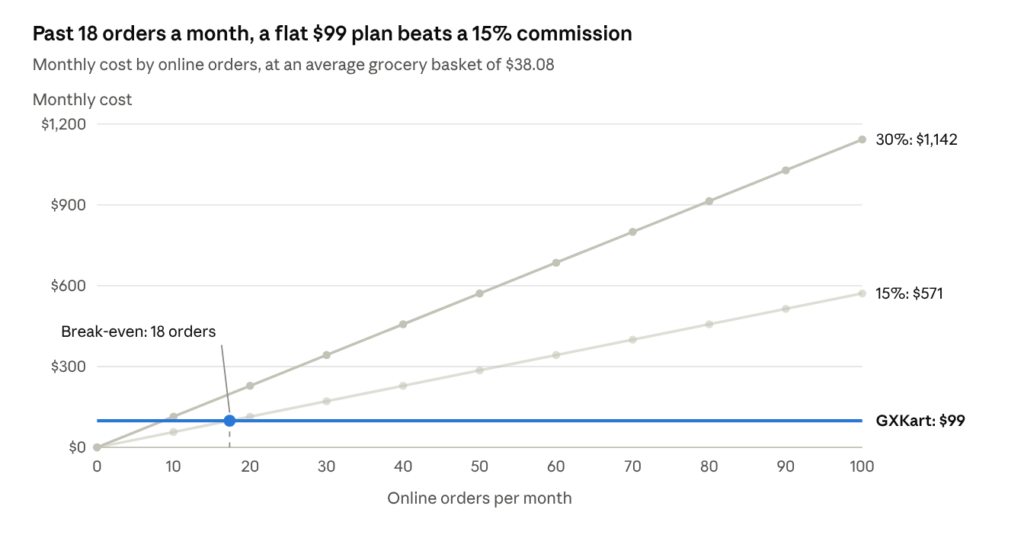
Against a 15% commission, the $99 website plan pays for itself at about 18 online orders a month. At 100 orders, a 15% commission costs $571 a month and a 30% commission costs $1,142, while GXKart stays at $99.
To compare fairly: a marketplace commission includes its couriers, while with GXKart you deliver with your own drivers or a delivery partner, so add that cost to your own figures. Card processing fees apply either way and are not shown.
5. What Can AI Do for a Grocery Store?
AI helps a grocery store in two ways: it predicts what shoppers will buy, so you stock better, and it personalises what each shopper sees, so they buy more. It works from data your store already creates every day.
Canadian businesses are moving fast. In the second quarter of 2026, 19.2% of businesses used AI to produce goods or deliver services, with data analytics the most common use, according to Statistics Canada. By the third quarter, 25.2% planned to use AI over the next 12 months, up from 10.6% two years earlier.
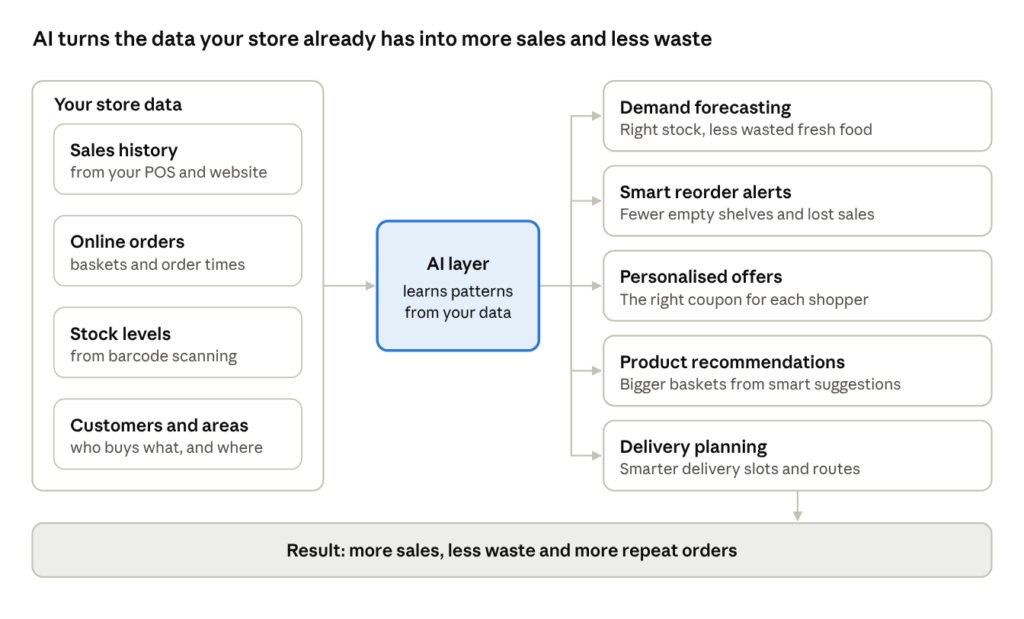
The biggest gain is usually in stock. McKinsey research, cited by Oracle, found that AI-powered forecasting can cut forecasting errors by 20% to 50% and product unavailability by up to 65%. For a grocer, that means fewer empty shelves, fewer lost sales and less fresh food thrown away.
The other gains come from the shopper’s side. Personalised coupons, smart product suggestions and better delivery slots make each order easier to place and a little larger, which is how a store grows without needing more foot traffic.
6. How GXKart Adds AI to Your Store
GXKart can add AI as a custom upgrade, built on the data your store already collects in GXKart. You choose the AI features that fit your goals, and Aprodence prices them once it understands your requirements.
| AI feature | GXKart data it learns from | How it helps your store grow |
|---|---|---|
| Demand forecasting | Sales from your POS and online orders | Order the right quantity and waste less fresh food |
| Smart reorder alerts | Scanner stock-in and stock-out | Fewer empty shelves and fewer lost sales |
| Personalised offers | Each customer’s orders and coupon use | More coupons redeemed and more repeat orders |
| Product recommendations | What shoppers buy together online | Bigger baskets on every order |
| Delivery planning | Delivery areas, timing and scheduled orders | Smoother delivery slots and lower delivery cost |
| AI shopping assistant | Your product catalogue | Shoppers find what they need and order faster |
How AI pricing works
AI is quoted, not fixed, because no two stores need the same thing. A single-store market may only want reorder alerts, while a busy delivery operation may want forecasting and route planning. Aprodence scopes the AI features in the discovery workshop, then gives you a clear price before any work starts.
A practical tip: AI learns from data. A sensible path is to start with the GXKart website or apps, build up a few months of sales and order history, then add AI when there is enough data for it to learn from.
7. How to Choose the Right Grocery Store Software
The right grocery store software is the one that matches where your sales come from today and where you want them to come from next. Start with your main need:
| If your main need is… | Look at… |
|---|---|
| Your own branded online store and apps, plus one system for the whole store | An all-in-one grocery system such as GXKart |
| An online shop for general products, with grocery features added later | A general e-commerce platform |
| Fast checkout and stock control, mostly in store | A POS-focused retail system |
| Extra reach from shoppers who already use delivery apps | A marketplace, alongside your own channel |
Questions to ask any provider:
- Do you take a commission on my orders, or charge a flat monthly price?
- Will shoppers order from my brand, or from yours?
- Does one system handle in-store billing, stock and online orders together?
- Can each product carry its own GST/HST status for zero-rated and taxable groceries?
- What AI features are available, what data do they use, and how are they priced?
- Who owns my customer data if I leave?
- Can I see the whole system working in a live demo?
8. Frequently Asked Questions
What is the best grocery store software in Canada?
For grocers who want to run the whole store and sell online under their own name, GXKart is one of the strongest choices. It combines a branded website, customer app, delivery app, admin panel and POS, with 0% commission on orders and pricing from $99 a month.
How much does grocery store software cost in Canada?
It depends on the model. GXKart costs $99 a month for a branded website with admin panel, and $99 a month for branded apps plus a one-time $999 setup. General platforms charge a monthly plan plus payment fees, while delivery marketplaces take 15% to 30% of each order.
How can AI help a grocery store?
AI helps a grocery store forecast demand, send smart reorder alerts, personalise offers, recommend products and plan deliveries. McKinsey research found AI-powered forecasting can cut forecasting errors by 20% to 50% and product unavailability by up to 65%, which means fewer empty shelves and less waste.
Does GXKart include AI?
GXKart can add AI as a custom upgrade, built on the sales, stock, order and delivery data your store already collects in GXKart. Features include demand forecasting, reorder alerts, personalised offers, recommendations, delivery planning and a shopping assistant, priced once Aprodence understands your requirements.
Is a flat monthly fee better than paying commission?
For most active stores, yes. At an average Canadian grocery basket of $38.08, GXKart’s $99 website plan costs less than a 15% commission once you pass about 18 online orders a month. Remember that a marketplace commission includes its couriers, so add your own delivery cost when you compare.
9. About This Guide
Who wrote it. This guide was written by Sayantan Pratihar of Aprodence Technologies LLP, the company that builds GXKart for grocery stores in Canada and Nigeria, including VICART. GXKart pricing and features come from our own product.
How we researched it. Market and AI figures come from Statistics Canada, McKinsey research cited by Oracle, NielsenIQ data reported by Retail Insider, the Retail Council of Canada and Food On Demand. Competitor descriptions reflect each provider’s public positioning as of October 9, 2026.
Our disclosure. GXKart is our product, and we placed it first. To keep the comparison fair, we describe where each alternative is strong, say where delivery apps still help, and show the delivery cost you take on when you leave a marketplace.
Last reviewed: October 9, 2026. We update this guide when prices or figures change.
10. Sources
- Statistics Canada, Analysis on artificial intelligence use by businesses in Canada, second quarter of 2026.
- Statistics Canada, Canadian Survey on Business Conditions, third quarter 2026, The Daily, August 31, 2026.
- Oracle, AI in Demand Forecasting: Overview, Use Cases, and Benefits (citing McKinsey & Company research).
- Sylvain Charlebois, Canadians Are Grocery Shopping More Often but Buying Less Each Time, Retail Insider, August 31, 2026 (NielsenIQ data).
- Hans Lammeman, How the Uber Eats Fees Stack Up Against 3PD Competitors, Food On Demand, April 1, 2026.
- Russell Redman, Canada sounds call for more grocery retail competition, Supermarket News, June 27, 2023 (Retail Council of Canada figures).
- Aprodence Technologies LLP, VICART: Multi-Platform Grocery Delivery Solution, case study.